
The Best Crime Fiction Authors for Unreliable Narrators have one thing in common: they understand that the most dangerous lies in any story are the ones the storyteller tells themselves.
There is no device in crime fiction more thrilling — or more treacherous — than the unreliable narrator. The Best Crime Fiction Authors for Unreliable Narrators do not merely withhold information; they construct entire architectures of false certainty, leading readers down corridors of plausible logic until the floor gives way. From Scandinavian procedural darkness to the meta-fictional games of British crime, from Irish rural noir to the grand, brutalising tradition of American hard-boiled, the authors on this list have each found a distinctive way to make doubt into a weapon. What unites them is craft, courage, and a fundamental mistrust of easy truth.
What Defines Best Crime Fiction Authors for Unreliable Narrators
An unreliable narrator in crime fiction is not simply a liar — that would be too easy. The best practitioners deploy narrators who are self-deceived, traumatised, complicit, or simply limited in ways they cannot fully perceive, and the reader’s job is to read between the lines of a perspective that feels entirely real from the inside. What separates the masters from the imitators is that the revelation of unreliability never feels like a cheat; it feels, in retrospect, like the only possible truth. These are writers who trust their readers enough to plant every clue in plain sight, knowing that the narrator’s own blind spots will do the concealment work for them.
The Series Worth Your Time

DCI Isaac Cook — Phillip Strang
19 books of London homicide fiction built on fractured testimony, hidden motives, and the kind of institutional deception that makes every witness suspect. If you prize crime fiction where nothing is quite as it appears on the surface, Cook’s London is your city.
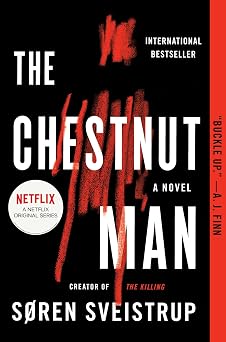
The Chestnut Man
Sveistrup, the creator of the television series The Killing, brings to his debut novel the same patient, suffocating dread that made Sarah Lund iconic — and in doing so, creates a thriller in which the reader is perpetually uncertain whose perspective to trust. The Chestnut Man is built on layered concealment: investigators who cannot see past their own grief, witnesses whose accounts shift under scrutiny, and a killer whose logic is internally coherent in ways that are genuinely disturbing. What makes this exceptional is how Sveistrup uses procedural detail not to establish certainty but to deepen confusion — every answered question opens two more. It is Scandinavian noir operating at its most claustrophobic and most formally ambitious.
Verdict: Sveistrup proves that the best screen crime writers can translate their mastery of misdirection directly onto the page.

The Word Is Murder
Horowitz has spent a career writing within established conventions — Poirot continuations, Bond novels, Midsomer Murders — but with The Word Is Murder he does something genuinely cunning: he inserts himself as the narrator, a fictionalised Anthony Horowitz who functions as Watson to the abrasive and deeply opaque Daniel Hawthorne. The unreliability here is structural rather than confessional. Horowitz-the-narrator is observant but persistently wrong about what he observes; he is present at every scene yet somehow always the last to understand it. The meta-fictional layer — a real author writing himself as an unreliable witness to fictional murders — is not a gimmick but a sustained formal argument about the nature of storytelling and the limits of the observer. It is also enormously entertaining, which is not nothing.
Verdict: The most sophisticated piece of self-aware crime fiction published this decade, disguised as a cosy procedural.

The Ruin
McTiernan’s debut is Irish crime fiction at its most psychologically rigorous, and what distinguishes it from the crowded field of rural noir is the precision with which she dismantles the reliability of memory itself. The Ruin operates across two timelines — a young detective’s traumatic discovery of a suspected murder twenty years before the present action — and the gap between what Cormac Reilly remembers, what he thinks he remembers, and what actually happened becomes the engine of the entire narrative. McTiernan is clinically exact about the way trauma reshapes recollection, and she never allows her protagonist the comfort of certainty even when he most craves it. The result is a thriller in which the most unreliable narrator is not a villain or a victim but the hero himself.
Verdict: McTiernan is one of the most formally intelligent crime writers working today, and The Ruin is the proof.

A MAYA THORNE MYSTERY
Get Dust and Bones Free
Justice runs deeper than drought.
Red dust. Shallow graves. A detective who hunts killers where the law runs thin and the nearest help is two hundred miles away.
You’ll also receive occasional new release emails. Unsubscribe anytime. No spam, ever.

The Best American Noir of the Century
If you want to understand why American crime fiction is the natural home of the unreliable narrator, this anthology — curated by James Ellroy, the most grandly unreliable voice in the entire tradition — is the essential document. Spanning nearly a hundred years and drawing on writers from Cornell Woolrich to Joyce Carol Oates, it demonstrates that the hard-boiled and noir traditions were built on fractured, compromised, self-interested voices from the very beginning. Ellroy’s editorial vision is characteristically autocratic and completely correct: noir is not a setting or a tone, it is a moral epistemology in which no one ever has the full picture and everyone believes they do. As a critical education in how crime fiction weaponises perspective, this anthology is without peer.
Verdict: Essential reading not just as entertainment but as a masterclass in how unreliable narration became the defining grammar of American crime fiction.
What to Read First
Begin with Dervla McTiernan’s The Ruin. It is the most immediately accessible entry point on this list, but it is also the most formally accomplished in its handling of memory as unreliability — and that theme sits at the heart of everything that makes the best crime fiction of this kind work. McTiernan does not announce her technique; she simply builds a world in which you gradually realise that the investigator you have trusted most completely is the one most thoroughly deceived by his own recollections. From there, move to Horowitz’s The Word Is Murder for a more playful but equally rigorous exploration of narrative deception, before working through Sveistrup’s Scandinavian darkness and finally immersing yourself in the Ellroy anthology to understand where all of this comes from historically. That reading order is not arbitrary — it moves from emotional to intellectual to historical, and each book reframes the ones that came before it.
The Reading Order
- The Ruin — Dervla McTiernan
- The Word Is Murder — Anthony Horowitz
- The Chestnut Man — Søren Sveistrup
- The Best American Noir of the Century — James Ellroy and Otto Penzler (Eds.)
Discover Phillip Strang
If what draws you to crime fiction is the sense that no testimony can be fully trusted and no perspective is ever quite complete, Phillip Strang’s DCI Isaac Cook series — nineteen books deep and set in the moral complexity of London homicide — is built on exactly that foundation. Strang’s detectives operate in institutional environments where official accounts conceal as much as they reveal, and the reader is persistently invited to read between the lines of what witnesses, colleagues, and suspects choose to say.

A MAYA THORNE MYSTERY
Get Dust and Bones Free
Justice runs deeper than drought.
Red dust. Shallow graves. A detective who hunts killers where the law runs thin and the nearest help is two hundred miles away.
Send Me the BookYou'll also receive occasional new release emails. Unsubscribe anytime. No spam, ever.
As an Amazon Associate, Phillip Strang earns from qualifying purchases. This page contains affiliate links — buying through them costs you nothing extra.