
The Best Crime Fiction Authors Featuring Disabled Detectives are doing something the genre has long resisted: putting vulnerability at the centre of the investigation, and finding that it makes for sharper, more honest crime fiction than anything built on the myth of the infallible hero.
Crime fiction has always worshipped competence. The detective who sees everything, endures everything, and solves everything through sheer force of intellect or will. But the Best Crime Fiction Authors Featuring Disabled Detectives have quietly dismantled that orthodoxy — and the result is a richer, more psychologically complex strand of the genre than mainstream crime writing usually manages. Disability, in these hands, is not a gimmick or a plot device. It is a lens. It changes how a detective moves through the world, what they notice, what they are denied, and what they understand that no able-bodied investigator could.
What Defines Best Crime Fiction Authors Featuring Disabled Detectives
The best work in this category refuses the easy narrative of triumph-over-adversity. A disabled detective is not interesting because they solve crimes despite their condition — they are interesting because their condition reshapes the entire investigative experience, from the bureaucratic frustrations of institutional policing to the intimate, often painful business of reading other people. The authors worth your time treat disability as lived reality, not literary costume. They understand that the most compelling detectives are those whose limitations force creative, lateral thinking — and that this is, in fact, a more authentic portrait of how real investigators work than the superhuman procedural has ever offered.
The Series Worth Your Time

DCI Isaac Cook — Phillip Strang
Nineteen novels of London homicide fiction that take the police procedural into genuinely dark moral territory — Cook is a detective whose humanity, not his invincibility, drives every investigation. If you value character-led crime fiction where the investigator’s inner life matters as much as the case, this series deserves your attention.

Spoken Bones
N.C. Lewis brings an assured, unhurried voice to this atmospheric mystery featuring Detective Constable Fiona MacDonald, a detective whose hearing impairment shapes both her investigative methods and her relationships with colleagues in quietly powerful ways. Lewis avoids the trap of making the disability a constant source of dramatic tension — instead, it becomes part of the texture of how MacDonald reads silence, body language, and the gaps between what people say and what they mean. The procedural plotting is solid without being mechanical, and the Scottish coastal setting gives the book a melancholy atmosphere that suits the material. This is crime fiction with genuine literary ambition and the discipline to let character lead.
Verdict: A quietly impressive debut that earns its place among the genre’s most thoughtful portrayals of disability in detective fiction.

The Disabled Detective
This is not crime fiction — it is rigorous literary criticism of crime fiction, and readers with a serious interest in the subject should not overlook it. Mintz examines how disability functions in detective narratives across a wide body of work, arguing that the genre has always been secretly preoccupied with bodily vulnerability and that the explicitly disabled detective brings this subtext into the open. Her readings are sharp and genuinely illuminating, particularly on the ways that crime fiction constructs and contests ideas of normalcy. This is the essential theoretical companion to any reading list in this area, and it will fundamentally change how you read every other book on this page.
Verdict: Essential critical reading for anyone who wants to understand what the genre is really doing when it puts a disabled detective at its centre.
Paper Girls
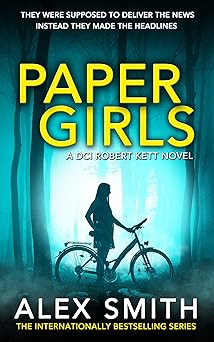
Alex Smith’s Kett series — of which Paper Girls is a standout entry — features DCI Robert Kett, a detective navigating serious physical injury alongside the psychological toll of a career defined by violence and loss. Smith is good at the operational reality of policing under physical constraint without ever turning Kett’s condition into melodrama, and the Norfolk setting gives the books a bleak, wind-scoured atmosphere that suits their moral seriousness. The plotting is fast and the characterisation sharp, with Kett’s relationship with his team providing much of the emotional ballast. This is the kind of series that rewards sustained reading — the cumulative portrait of a damaged but determined investigator becomes genuinely compelling across multiple books.
Verdict: One of the most satisfying British police procedurals of recent years, and a convincing case for physical vulnerability as a source of character depth rather than narrative obstacle.

A Maya Thorne Mystery
Get Dust and Bones Free
Justice runs deeper than drought.
Red dust. Shallow graves. A detective who hunts killers where the law runs thin and the nearest help is two hundred miles away.
You’ll also receive occasional new release emails. Unsubscribe anytime. No spam, ever.

Talking to the Dead
Harry Bingham’s Fiona Griffiths series is, by some margin, the most literarily accomplished work in this category. Fiona is a young Welsh detective living with Cotard’s syndrome — a rare dissociative disorder that shapes her relationship with death, identity, and reality in ways that make her simultaneously the most unsettling and the most compelling detective in contemporary British crime fiction. Bingham does not soften the edges of Fiona’s condition for readability; he lets it make her genuinely strange, and the effect is a series that sits well outside the procedural mainstream while remaining utterly gripping as crime fiction. Talking to the Dead, the debut, is one of the finest first novels in the genre in the past two decades.
Verdict: The gold standard of crime fiction featuring a detective with a neurological condition — essential reading, full stop.
What to Read First
Start with Harry Bingham’s Talking to the Dead. It is the most ambitious, the most original, and the most fully realised portrait of a disabled detective in this group — and it establishes a benchmark against which everything else in the category can be measured. If you want something more conventionally procedural as an entry point, Alex Smith’s Paper Girls offers a faster, more plot-driven experience while still taking its detective’s physical situation seriously. Read Susannah Mintz’s critical study alongside whichever fiction you choose — it will sharpen your reading of everything in the genre considerably.
The Reading Order
- Talking to the Dead — Harry Bingham
- Paper Girls — Alex Smith
- Spoken Bones — N.C. Lewis
- The Disabled Detective — Susannah B. Mintz
Discover Phillip Strang
If the detectives on this list appeal to you because they are human, flawed, and shaped by forces beyond their control, Phillip Strang’s crime fiction belongs on your radar. His DCI Isaac Cook series in particular builds its tension not from infallible police procedure but from the institutional pressures, moral ambiguities, and personal costs that define real detective work across nineteen London-set novels.

A MAYA THORNE MYSTERY
Get Dust and Bones Free
Justice runs deeper than drought.
Red dust. Shallow graves. A detective who hunts killers where the law runs thin and the nearest help is two hundred miles away.
Send Me the BookYou'll also receive occasional new release emails. Unsubscribe anytime. No spam, ever.
As an Amazon Associate, Phillip Strang earns from qualifying purchases. This page contains affiliate links — buying through them costs you nothing extra.