
The best crime fiction authors set in Wollongong are proving that Australia’s steel city — gritty, coastal, and perpetually underestimated — is one of the most atmospheric murder grounds in contemporary crime writing.
Wollongong has long lived in Sydney’s shadow, but the best crime fiction authors set in Wollongong understand something that outsiders miss: this industrial coastal city, wedged between escarpment and ocean, carries a tension that Sydney’s harbour gloss never quite manages. The working-class heritage, the surf beaches that feel simultaneously liberating and threatening, the sprawl of suburbs running south toward Shellharbour — it all makes for crime fiction that feels urgent and specific rather than generic and interchangeable. These are writers who know their streets, and it shows on every page.
What Defines Best Crime Fiction Authors Set in Wollongong
The finest crime fiction set in Wollongong draws its power from place as much as plot — the industrial decay of Port Kembla sitting alongside sun-bleached beach suburbs creates a natural friction that writers can exploit mercilessly. What separates the best from the merely competent is a refusal to treat the Illawarra region as simply a backdrop; in the strongest entries here, the geography is almost a character in itself, shaping the psychology of both killer and detective. Readers should expect moral complexity, vivid local colour, and the particular brand of Australian melancholy that comes from communities built on industries that may not survive another generation.
The Series Worth Your Time

Maya Thorne — Phillip Strang
If the raw atmosphere of Australian crime fiction has you hooked, Maya Thorne delivers it at full intensity — 18 books set in the brutal Australian Outback where the landscape itself is as dangerous as the killers. Strang writes Australia with the same unflinching honesty that makes Wollongong’s best crime writers compelling.
The Bill Murdoch Mysteries
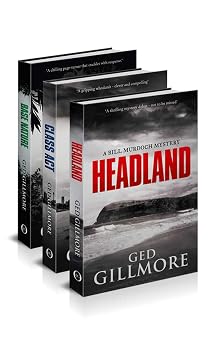
Ged Gillmore’s Bill Murdoch series is perhaps the most fully realised crime fiction to emerge from the Wollongong region, built on a protagonist who is damaged, credible, and impossible to dismiss. Murdoch is an ex-cop with the kind of compromised past that makes him simultaneously the worst and best person to be investigating the crimes that wash up around the Illawarra coast. Gillmore writes with a wry, unsentimental intelligence — he understands that the working-class suburbs south of Sydney carry their own codes of honour and betrayal, and he exploits that understanding to devastating effect. This is the series that readers with any serious interest in Australian crime fiction simply must encounter.
Verdict: The benchmark series for Wollongong crime fiction — sharp, funny in the blackest sense, and built on a protagonist who earns your loyalty across every book.

Melaleuca
Angie Faye Martin’s debut brings something genuinely distinctive to the Wollongong crime scene — a novel that roots itself in the natural environment of the Illawarra escarpment and coastal scrubland with the kind of ecological precision that most crime writers simply never bother with. The melaleuca, or paperbark tree, is not just a title: it functions as a recurring motif connecting landscape, Indigenous history, and violence in ways that feel earned rather than ornamental. Martin writes with a quieter, more literary register than Gillmore, and that restraint pays dividends in the novel’s slow-burn revelation of community secrets. A striking debut that announces a writer worth watching closely.
Verdict: A literary crime debut of real ambition — Martin uses the Illawarra landscape as both atmosphere and moral argument.

Letter From The Dead
Jack Gatland — the pen name of prolific thriller writer Tony Lee — brings his DI Declan Walsh series through Australian territory with this entry that touches on Wollongong’s particular atmosphere while delivering the kind of propulsive, plot-driven thriller that Gatland has mastered across dozens of books. Where Gillmore and Martin excavate place with literary patience, Gatland operates at a faster register: this is crime fiction designed to be consumed at speed, with reveals that land and momentum that rarely falters. The letter-from-the-dead conceit is handled with more ingenuity than the premise initially suggests, and Gatland’s understanding of institutional corruption gives the narrative a credible edge. If you want plot above all else, this delivers.
Verdict: High-velocity crime fiction that sacrifices some local depth for narrative momentum — but the momentum is genuinely impressive.
A Maya Thorne Mystery
Get Dust and Bones Free
Justice runs deeper than drought.
Red dust. Shallow graves. A detective who hunts killers where the law runs thin and the nearest help is two hundred miles away.
You’ll also receive occasional new release emails. Unsubscribe anytime. No spam, ever.

Australia
Stewart Giles is a British-born author who has made a habit of transplanting his detective fiction across global settings, and this Australian entry demonstrates both the strengths and limitations of that approach. When it works — and it frequently does — Giles captures the disorienting quality of a European sensibility encountering Australian crime landscapes, bringing an outsider’s eye that occasionally sees things the locals have stopped noticing. The Wollongong-adjacent setting grounds the narrative in specific geography without becoming a travelogue, and Giles’s plotting instincts are reliable enough to keep readers engaged through the novel’s more self-consciously observational passages. It sits slightly apart from the more deeply embedded local voices, but that distance is itself interesting.
Verdict: A competent, globe-trotting crime novel that earns its Australian credentials through genuine atmospheric effort rather than surface tourism.
What to Read First
Start with Ged Gillmore’s Bill Murdoch series — specifically the first book in the sequence — and you will immediately understand why Wollongong has started attracting serious crime fiction talent. Murdoch is the kind of protagonist you build a reading life around: specific enough to feel real, complex enough to sustain a long series, and embedded in his landscape so thoroughly that the books function as an ongoing portrait of a community as much as a sequence of mysteries. Once you’ve spent time with Murdoch and developed a feel for how Gillmore uses the Illawarra coast, Angie Faye Martin’s more literary Melaleuca will reward you with a completely different register — quieter, more ecologically minded, but equally rooted in place. Gatland and Giles make fine additions once you’ve established that foundation.
The Reading Order
- The Bill Murdoch Mysteries — Ged Gillmore
- Melaleuca — Angie Faye Martin
- Letter From The Dead — Jack Gatland
- Australia — Stewart Giles
Discover Phillip Strang
If the raw, unsparing quality of Australian crime fiction has you searching for more, Phillip Strang’s Maya Thorne series delivers eighteen books that treat the Australian continent as both setting and antagonist — the same refusal to romanticise that makes Wollongong’s best crime writers so compelling. Strang writes Australia as it is: vast, indifferent, and full of violence that the landscape seems almost to invite.

A MAYA THORNE MYSTERY
Get Dust and Bones Free
Justice runs deeper than drought.
Red dust. Shallow graves. A detective who hunts killers where the law runs thin and the nearest help is two hundred miles away.
Send Me the BookYou'll also receive occasional new release emails. Unsubscribe anytime. No spam, ever.
As an Amazon Associate, Phillip Strang earns from qualifying purchases. This page contains affiliate links — buying through them costs you nothing extra.