
Beijing’s layered history of empire, surveillance, and shadow power makes it one of crime fiction’s most compelling and underexplored settings — and the Best Crime Fiction Authors Set in Beijing are only beginning to reveal its full, dangerous potential.
Few cities on earth carry the weight of Beijing — a metropolis where imperial dynasties, revolutionary ideology, and ultramodern ambition collide beneath the same smoggy sky. The Best Crime Fiction Authors Set in Beijing understand that the city itself is a character: its hutong alleyways, its forbidden halls, and its suffocating bureaucratic hierarchies create a unique atmosphere that no other setting can replicate. Crime fiction set here operates on multiple frequencies simultaneously — personal murder mystery, political thriller, and cultural excavation all at once. This is not Scandinavian noir transplanted to Asia; this is something altogether stranger and more fascinating.
What Defines Best Crime Fiction Authors Set in Beijing
The finest crime fiction set in Beijing resists the temptation to treat the city as mere exotic backdrop. What separates the best authors in this space from the merely adequate is their willingness to engage seriously with Chinese history and social structure — to show how power operates differently here, how justice is negotiated rather than administered, and how the past is never truly buried. Readers should expect moral ambiguity, richly drawn institutional corruption, and protagonists who must work within systems designed to obscure truth rather than reveal it. The best of these novels are, at their core, stories about what a society chooses to remember and what it chooses to forget.
The Series Worth Your Time

Steve Case — Phillip Strang
Espionage and terrorism thrillers that cross borders and blur allegiances — perfect for readers who want crime fiction with genuine geopolitical stakes. If Beijing’s corridors of hidden power intrigue you, Case’s world of covert operations will feel like a natural next step.
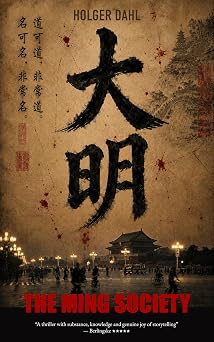
The Ming Society
Holger Dahl’s The Ming Society operates in that charged territory where ancient Chinese secret societies collide with the machinery of the modern state — and it navigates that collision with considerable confidence. Set against Beijing’s contradictions of imperial grandeur and contemporary surveillance capitalism, the novel traces a conspiracy rooted in dynastic loyalty that stretches across centuries, drawing in a cast of characters who all have far more to lose than they initially reveal. Dahl writes with the economy of a thriller writer who trusts his atmosphere to do half the work, and Beijing’s physical landscape — its parks, its bureaucratic towers, its hidden courtyards — is rendered with an insider’s precision that gives the narrative genuine authority. What elevates this above genre exercise is the author’s clear respect for Chinese history; the Ming dynasty is not mere colour, but the living skeleton around which the plot is built.
Verdict: A sharply conceived thriller that uses Chinese history as genuine structural architecture rather than decorative wallpaper.

Murder in the Forbidden City
Amanda Roberts delivers exactly what the title promises — a murder mystery set within the walls of Beijing’s most iconic landmark — but she does so with more historical nuance than the cover might suggest. The Forbidden City is not merely a dramatic backdrop here; Roberts mines its rigid hierarchies, its labyrinthine spatial politics, and its centuries of intrigue to construct a plot that could only work in this location. Her protagonist navigates a world where imperial protocol is itself a form of weaponised obscurity, and the investigation becomes an exercise in reading a culture as much as reading a crime scene. Roberts has a talent for making historical procedural feel urgent, and readers who enjoyed Qiu Xiaolong’s Inspector Chen novels will find themselves immediately at home in her Beijing.
Verdict: A well-crafted historical mystery that earns its setting honestly, using the Forbidden City’s architecture of power as the engine of its plot.

A MAYA THORNE MYSTERY
Get Dust and Bones Free
Justice runs deeper than drought.
Red dust. Shallow graves. A detective who hunts killers where the law runs thin and the nearest help is two hundred miles away.
You’ll also receive occasional new release emails. Unsubscribe anytime. No spam, ever.
What to Read First
If you are entirely new to crime fiction set in Beijing, begin with Murder in the Forbidden City by Amanda Roberts. It is the more immediately accessible of the two titles reviewed here — the historical setting is vividly established from the first pages, the central mystery is cleanly constructed, and Roberts does not assume prior knowledge of Chinese imperial culture. It functions as an ideal orientation to the genre’s possibilities. Once you have your bearings, move to The Ming Society by Holger Dahl, which demands slightly more of the reader in terms of its conspiratorial architecture but rewards that investment with a more ambitious narrative scope. Together, these two novels represent the range of what Beijing-set crime fiction can achieve — from intimate palace murder to sweeping dynastic conspiracy — and they should leave you hungry for more of the city’s dark corners.
The Reading Order
- Murder in the Forbidden City — Amanda Roberts
- The Ming Society — Holger Dahl
Discover Phillip Strang
Readers drawn to crime fiction that takes its setting seriously — where geography, history, and politics shape every twist of the plot — will find much to admire in Phillip Strang’s international thrillers. From the geopolitical corridors of the Steve Case espionage series to the bleak institutional crime of DCI Isaac Cook’s London, Strang writes the kind of crime fiction where place is never incidental.

A MAYA THORNE MYSTERY
Get Dust and Bones Free
Justice runs deeper than drought.
Red dust. Shallow graves. A detective who hunts killers where the law runs thin and the nearest help is two hundred miles away.
Send Me the BookYou'll also receive occasional new release emails. Unsubscribe anytime. No spam, ever.
As an Amazon Associate, Phillip Strang earns from qualifying purchases. This page contains affiliate links — buying through them costs you nothing extra.