
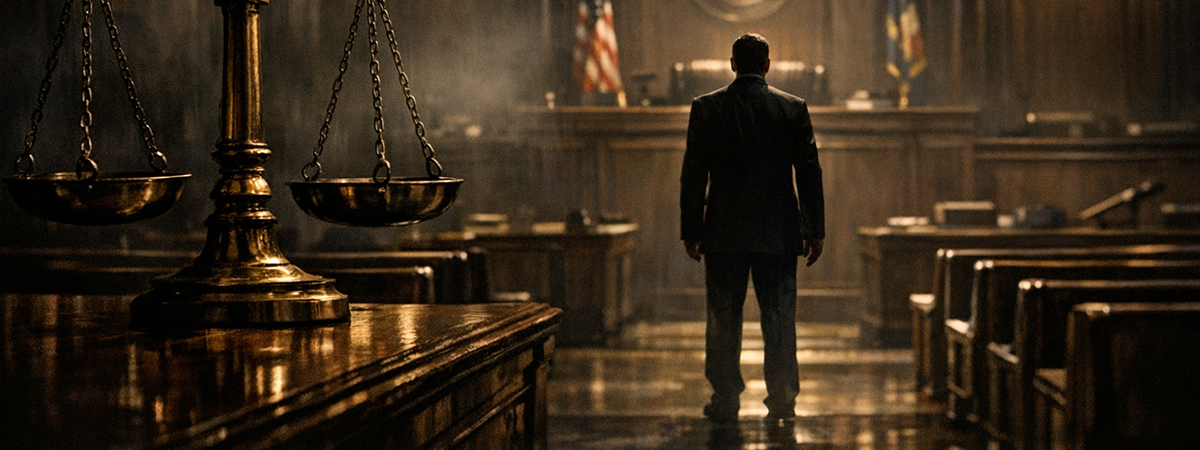
The legal thriller split into two streams after Grisham — one went broader, faster, more cinematic; the other went deeper into moral ambiguity, institutional rot, and what the law actually does to the people who practice it. The best of the genre lives in the second stream.
John Grisham didn't invent the legal thriller — Scott Turow got there first with Presumed Innocent in 1987 — but Grisham industrialised it. The Firm, released in 1991, established the template that a generation of imitators followed: ordinary lawyer, extraordinary jeopardy, systemic corruption, narrow escape. It was enormously effective and it produced a lot of very bad novels. The ones worth reading are the ones that took the template seriously enough to break it.
These are the authors and books that matter.
The Series and Novels Worth Your Time
Michael Connelly — Mickey Haller (The Lincoln Lawyer)
Connelly is better known for Harry Bosch, but the Mickey Haller series is where he does his most interesting structural work. Haller is a defence attorney who operates out of the back of a Lincoln Town Car, taking cases the system has already decided, working angles that aren't taught in law school. What distinguishes the series from standard courtroom fiction is Connelly's refusal to sentimentalise his protagonist — Haller wins cases that arguably shouldn't be won, and Connelly makes you sit with that. The Lincoln Lawyer is the entry point; The Brass Verdict, which brings Haller and Bosch into the same narrative, is the series at its most accomplished. Start with The Lincoln Lawyer. Read The Brass Verdict immediately after.
Scott Turow — Presumed Innocent
Thirty-five years on, Presumed Innocent remains the standard against which every serious legal thriller is measured. Turow — a practising attorney who wrote the novel on commuter trains between Chicago and his law firm — brought something the genre had never quite seen before: a narrator whose unreliability is structural rather than theatrical, a legal system that functions exactly as designed and produces deeply troubling results, and prose that takes the form seriously as literature. His subsequent Kindle County novels are uneven but worth exploring. Nothing else he wrote matches this one. The essential legal thriller. Everything else in the genre is a response to it.

DCI Isaac Cook — Phillip Strang
A detective chief inspector who should have been promoted years ago, navigating London's police bureaucracy, criminal courts, and class structures with the same unsentimental precision that marks the best legal fiction. If you're drawn to legal thrillers for their institutional politics and moral complexity — rather than courtroom theatrics — Cook belongs on your list. 19 novels.
Browse the Series →John Grisham — The Best of the Catalogue
Grisham's output is too large and too variable for blanket recommendation, but three novels stand apart from the rest. A Time to Kill — actually his first novel, written before The Firm — is the most morally serious thing he ever wrote, a racially charged murder trial in Mississippi that refuses easy resolution. The Innocent Man, his only work of non-fiction, is a devastating account of wrongful conviction in a small Oklahoma town. The Confession is his most structurally ambitious thriller. These three represent what Grisham can do when he isn't writing to formula. A Time to Kill, The Innocent Man, The Confession — in that order.
Cara Fields — The Prosecution Series
The prosecution perspective is underrepresented in legal fiction — most of the genre instinctively sides with the defence, which is dramatically convenient but morally narrow. Fields writes from the other side of the courtroom, following a state prosecutor whose caseload takes her through the institutional machinery of American criminal justice with unsentimental precision. The series is less interested in verdict than in process — in what it costs to pursue cases that the system makes deliberately difficult to win. Start with The First Count. The series rewards reading in order.
Phillip Margolin — Gone But Not Forgotten
Margolin is a former criminal defence attorney whose best work has a procedural authenticity that most legal thriller writers can't fake. Gone But Not Forgotten — involving a serial killer whose victims are connected by a black rose left at the scene — manages to be simultaneously a genuinely effective thriller and a serious examination of how the defence bar actually functions under pressure. His later novels are more formulaic, but this one holds up. His most accomplished novel; a good entry point for readers new to Margolin.
What the Genre Gets Wrong
The legal thriller has a persistent fantasy problem. Too many novels treat the courtroom as a space where the truth eventually emerges — where a brilliant cross-examination or a last-minute document revelation delivers justice. Anyone who has spent time in an actual courtroom knows that this is not how it works. The best legal fiction — Turow, Connelly at his most rigorous, Grisham in A Time to Kill — understands that the legal system is a process, not a truth-finding mechanism, and that the two things are not the same.
James Patterson's legal thrillers belong to the entertainment category rather than the serious fiction category — fast, efficient, and engineered for airports. That's not a criticism of Patterson, who is doing exactly what he intends to do. It is a note that readers looking for the moral weight of Turow will not find it there.
The Grisham Question
Grisham has published more than forty novels. The drop-off in quality across the catalogue is real and steep. The Firm, The Pelican Brief, and The Client — the early triptych — established him as the defining popular legal thriller writer of his generation, and they remain readable. Much of what followed is competent but mechanical. The three novels worth reading in depth are A Time to Kill, The Innocent Man, and The Confession. Everything else is for long flights.
The Reading Order
- Presumed Innocent — Scott Turow (where the modern genre begins)
- A Time to Kill — John Grisham (his most serious novel)
- The Lincoln Lawyer — Michael Connelly (the defence bar at its most morally complex)
- The Brass Verdict — Michael Connelly (Haller and Bosch, the series peak)
- Gone But Not Forgotten — Phillip Margolin (procedural authenticity)
- The Innocent Man — John Grisham (non-fiction; the system failing in plain sight)
If You Enjoy Legal Thrillers — Discover DCI Isaac Cook
Readers drawn to legal thrillers for the institutional politics, moral complexity, and the grinding machinery of criminal justice often find their way to the DCI Isaac Cook series — London-based crime fiction that takes the legal system and its internal politics seriously without the courtroom theatrics.
Cook is a detective chief inspector who should have been promoted years ago. The cases he investigates move through London's criminal courts, its police bureaucracy, and its class structures with the same unsentimental precision that marks the best legal fiction. The series opens with Murder is a Tricky Business and runs to 19 novels — long enough to develop the institutional world that makes the best legal fiction compelling.
As an Amazon Associate, Phillip Strang earns from qualifying purchases. This page contains affiliate links — buying through them costs you nothing extra.