
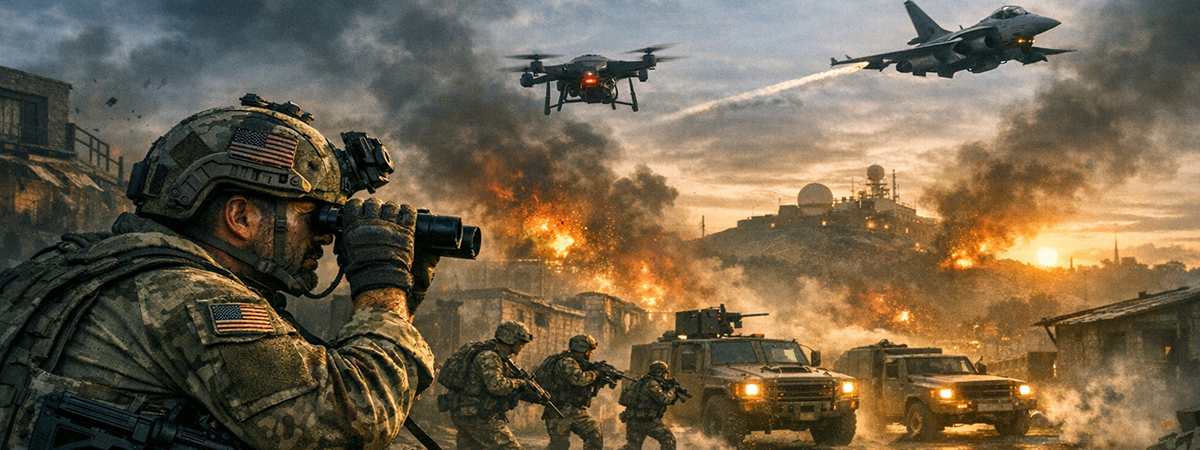
The military thriller demands two things simultaneously: authentic operational detail and a protagonist worth following into places most people will never go. The series below deliver both — written by people who either served, researched obsessively, or both.
The military thriller has a credibility problem that other genres don't. Readers who have served — or who know people who have — will put down a novel the moment the author gets the details wrong. The weapon that doesn't work that way. The rank structure that makes no sense. The tactical decision that no trained soldier would ever make. The best authors in the genre earn their readers' trust through research and authenticity, and hold it by building characters whose military background shapes not just what they do but how they think.
These are the five that get it right.
The Series Worth Your Time
Tom Clancy — Jack Ryan
Clancy's achievement was to take the technical apparatus of modern warfare — submarine sonar systems, carrier battle groups, satellite intelligence, nuclear command structures — and make it not just comprehensible but genuinely gripping. The Hunt for Red October, published in 1984, is still the foundational text of the techno-military thriller, and it remains remarkable: a novel in which the tension derives entirely from competing institutional decisions and navigational geometry, with barely a shot fired. Jack Ryan started as an analyst, a man whose advantage was his mind, and the early novels have a different character from the action-forward thrillers that followed. The later Ryan universe, expanded across multiple authors and spin-off series, is more variable in quality — but the core Clancy novels from the 1980s and early 1990s represent the genre at its most ambitious. The Hunt for Red October first. Clear and Present Danger for the politics. The Sum of All Fears for the scale.
Vince Flynn — Mitch Rapp
Where Clancy's Ryan operates through institutions, Flynn's Mitch Rapp operates around them. Rapp is a CIA counterterrorism operative — former collegiate athlete, man of controlled and precise violence, someone the agency deploys when the legitimate options have been exhausted and the clock is running. Flynn was writing about Islamic terrorism and covert American operations before September 2001, and the early Rapp novels have a prescience that gives them a different weight from the genre's more opportunistic entries. The series continued after Flynn's death in 2013 under Kyle Mills, who has sustained both the character and the quality with considerable skill. American Assassin is the origin story and the entry point. Consent to Kill is the most emotionally serious novel in Flynn's own run.

Alex Harlan — Phillip Strang
FBI agent Alex Harlan works cases that take him well beyond domestic law enforcement — into territory where military and intelligence operations intersect with criminal investigation, and where the rules governing what is permitted don't always map onto what is necessary. Operationally grounded and internationally scaled, across 6 novels from the American interior to Jakarta.
Browse the Series →Brad Thor — Scot Harvath
Thor's Scot Harvath — Navy SEAL turned Secret Service agent turned private intelligence operative — represents the evolution of the military thriller protagonist into something more hybrid: part special forces operator, part intelligence officer, part geopolitical troubleshooter. Thor's research into special operations doctrine, counterterrorism procedures, and international security is meticulous, and the series has grown more sophisticated in its treatment of the moral costs of covert operations as it has developed. The plotting is relentless and the tradecraft details are convincing. The Lions of Lucerne for the beginning. Near Dark and Black Ice for the series at full maturity.
Andy McNab — Nick Stone
McNab served with the SAS and took part in operations that he later wrote about in Bravo Two Zero, still one of the most widely read military memoirs ever published. The Nick Stone series draws on that operational background to produce military thrillers with a texture that purely civilian authors cannot replicate — the physical reality of close-quarters combat, the psychology of men trained to operate in extreme situations, the institutional culture of special forces. Stone himself is a complicated protagonist: capable of extreme violence, not always sympathetic, and more morally ambiguous than the heroes of most genre thrillers. That ambiguity is precisely what makes the series worth reading. Remote Control starts the series and establishes both the character and the tone.
Chris Ryan — various series
Ryan also served with the SAS — he was the only member of the Bravo Two Zero patrol to escape capture — and his fiction carries the same operational authenticity as McNab's, with a somewhat different emphasis. Where McNab tends toward the psychological complexity of men shaped by extreme experience, Ryan's thrillers are more propulsive, more focused on pace and action, and more willing to operate within the conventions of the genre. The Strike Back series and the Danny Black novels represent the range of his output. For readers who want military fiction that moves fast and gets the details right, Ryan is consistently reliable. Strike Back is the entry point for new readers; the Danny Black series for those who want something grittier.
The American and British Traditions
There is a meaningful difference between the American and British military thriller traditions. The American tradition — Clancy, Flynn, Thor — tends toward the geopolitical: global threats, institutional responses, protagonists who operate at the intersection of military and intelligence worlds. The British tradition — McNab, Ryan — is more personal and more operationally specific, rooted in the experience of men who have actually done the work rather than researched it from the outside.
Neither is superior. They satisfy different appetites. Readers who come to the genre for strategic scope tend toward the American tradition; readers who come for operational authenticity and the psychology of soldiers tend toward the British one. The best approach is to read both.
What Doesn't Work
The military thriller suffers more than most genres from the celebrity author problem — novels published under the names of retired generals or former special forces operators that were largely written by ghostwriters, with the attributed author providing a name and a credential rather than a manuscript. The results are rarely as good as the genuine article. When the operational detail feels generic and the protagonist feels like a composite rather than a person, that is usually why.
Where to Start
- The Hunt for Red October — Tom Clancy (where the genre was redefined)
- American Assassin — Vince Flynn (the Rapp origin story)
- Remote Control — Andy McNab (SAS authenticity from book one)
- The Lions of Lucerne — Brad Thor (Harvath from the beginning)
- Strike Back — Chris Ryan (fast, authentic, hard to put down)
If You Enjoy Military Thrillers — Discover Alex Harlan
Readers who come to military fiction for internationally grounded plots, protagonists operating at the edge of institutional authority, and cases that cross borders and jurisdictions often find their way to the Alex Harlan series.
Harlan is an FBI agent whose cases take him well beyond domestic law enforcement — into the kind of territory where military and intelligence operations intersect with criminal investigation, and where the rules governing what is permitted don't always map onto what is necessary. The series opens with Ridge Lines and moves through six novels spanning locations from the American interior to Jakarta. For readers who like their thrillers operationally grounded and internationally scaled, this is a series worth knowing.
As an Amazon Associate, Phillip Strang earns from qualifying purchases. This page contains affiliate links — buying through them costs you nothing extra.