
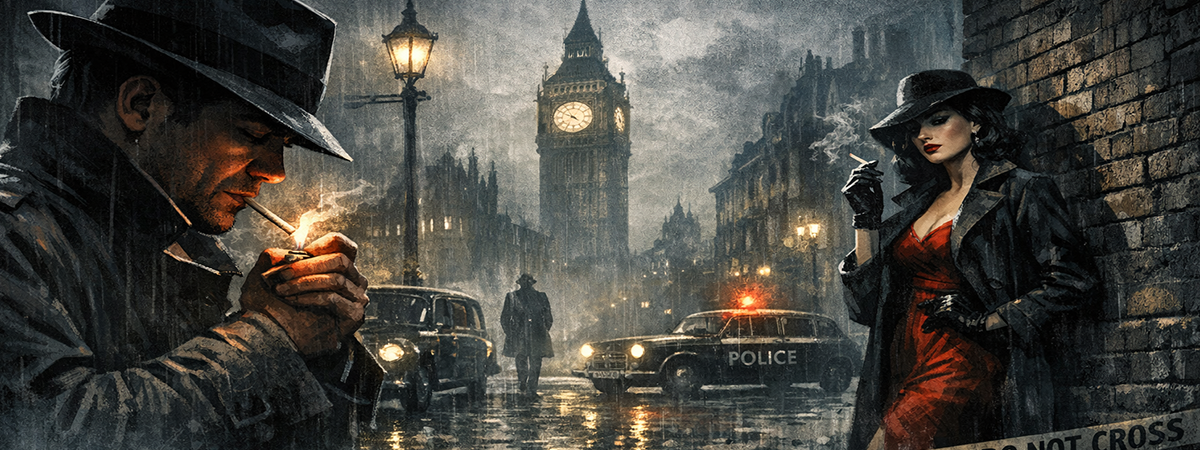
Noir isn't a setting or a plot type — it's a moral stance. The world is corrupt, the institutions are compromised, and the protagonist is going to lose something before the end. These are the best noir crime thriller novels that understand that, and use it to tell the truth.
The word noir gets applied to almost anything dark in crime fiction, which has diluted it to the point of meaninglessness. A rainy Edinburgh detective novel is not noir. A thriller with a morally ambiguous protagonist is not noir. Noir is something more specific and more unforgiving: a tradition in which the forces arrayed against the protagonist are not just criminals but the entire social and institutional order, in which moral compromise is not a character flaw but a structural necessity, and in which the idea that justice will be served is always in question.
The authors below understand what noir actually is. They are not writing dark crime fiction. They are writing about the cost of living in a world where power protects itself.
The Best Noir Crime Thriller Novels Worth Your Time
James Ellroy — L.A. Quartet and Underworld USA
Ellroy is the most important American crime novelist of the last forty years, and the argument is not close. The L.A. Quartet — The Black Dahlia, The Big Nowhere, L.A. Confidential, White Jazz — is the most sustained achievement in noir fiction since Chandler, and in some ways surpasses it. Ellroy's Los Angeles is a city built on corruption so deep and structural that individual acts of violence are almost beside the point. The prose in White Jazz in particular — compressed, staccato, almost telegraphic — is one of the genuinely original voices in American literary fiction. The Underworld USA trilogy that followed is even more ambitious, building a counter-history of Cold War America from the Kennedy assassination through to Watergate. L.A. Confidential for the uninitiated. White Jazz for those ready for the full force of what Ellroy can do.
George Pelecanos — Washington D.C. Crime Fiction
Pelecanos has spent thirty years building a body of work that does for Washington D.C. what Ellroy did for Los Angeles — using crime fiction as a vehicle for examining the social geography, racial politics, and economic fault lines of a city that most fiction treats as a backdrop for political intrigue rather than a place where ordinary people live. His protagonists — private investigators, bar owners, former cops — are working-class men navigating a city in constant flux. The Derek Strange series and the standalone novels are equally strong. Pelecanos has also written extensively for television, including The Wire and Treme, and that influence shows in the density and authenticity of his characterisation. A Firing Offense for the beginning of his career; The Night Gardener for the peak.

DCI Isaac Cook — Phillip Strang
A Black detective in the Metropolitan Police working homicide cases through London's criminal networks, institutional corruption, and the gap between what detectives can do and what the system permits. If you read Ellroy for institutional honesty and Pelecanos for social geography, Cook belongs in that tradition — nineteen novels deep into one of the most honest portraits of contemporary London crime fiction available.
Browse the Series →S.A. Cosby — Southern Noir
Cosby has emerged as the most important voice in contemporary American noir, and Blacktop Wasteland — his breakout 2020 novel — announced a major talent. Cosby writes the American South with the same specificity and complexity that Ellroy brought to Los Angeles: a landscape of poverty, race, and violence in which his protagonists are men trying to escape their pasts in places that won't let them. Blacktop Wasteland follows a Black mechanic and former getaway driver pulled back into a life he thought he had left behind. Razorblade Tears — his follow-up — is equally powerful. The moral seriousness of the work, combined with plotting that is genuinely propulsive, makes Cosby the natural successor to the great American noir tradition. Blacktop Wasteland first. Razorblade Tears immediately after.
Garry Disher — Australian Noir
Disher is the most consistently excellent Australian crime novelist working today, and one of the most underappreciated crime writers in the English-speaking world. His Wyatt series — a career criminal in the tradition of Richard Stark's Parker — is lean, precise, and morally unblinking. The Hal Challis and Paul Hirschhausen series are different in register: quieter, more procedural, more interested in the texture of rural Australian life and the particular kind of isolation it produces. What connects them is Disher's refusal to sentimentalise. His criminals are not redeemable, his detectives are not heroes, and his landscapes — the Mornington Peninsula, the Clare Valley, the Victorian countryside — are rendered with documentary precision. Wyatt for the purest noir. The Heat for the Hirschhausen series at its best.
Michael Connelly — Harry Bosch
Connelly straddles the line between noir and procedural more carefully than any other contemporary crime writer. The Bosch novels are police procedurals in their architecture but noir in their sensibility: Los Angeles as a city of institutional failure, racial inequality, and systemic injustice, with Bosch as a detective whose righteousness is inseparable from his damage. The early novels — The Black Echo, The Black Ice, The Concrete Blonde — established a template that Connelly has refined across two dozen books without ever losing the essential tension. The later novels, particularly The Drop and The Burning Room, are the work of a writer who has earned the complexity he is now deploying. The Black Echo starts the series. The Lincoln Lawyer for something different from the same world.
What Separates Noir from Dark Crime Fiction
The distinction matters because it affects what you should expect from a noir novel. In conventional crime fiction — however dark — the detective restores order. The killer is caught, the mystery is solved, and the world returns to something like equilibrium. Noir doesn't offer that. The best noir crime thriller novels end with a partial resolution at best: the immediate problem is resolved, but the structural conditions that created it remain entirely intact. Ellroy's detectives catch their killers but remain complicit in the corruption they exposed. Cosby's protagonists survive but at costs that cannot be recovered.
This is not pessimism for its own sake. It is honesty about how the world operates, and it is what gives the best noir fiction its lasting weight.
Nordic Noir — A Note
The Nordic noir wave of the 2000s — Stieg Larsson, Jo Nesbø, Henning Mankell — brought a different tradition to English-language readers: bleaker landscapes, more bureaucratic institutions, protagonists whose alcoholism and dysfunction felt structural rather than incidental. At its best, as in Mankell's Wallander or Nesbø's Harry Hole, this tradition produced genuinely important crime fiction. At its worst it produced a great deal of imitation that mistook depression for depth and a grey colour palette for moral seriousness. The originals are worth reading. The imitators are not.
Where to Start
- L.A. Confidential — James Ellroy (the most accessible entry point into the greatest American noir series)
- Blacktop Wasteland — S.A. Cosby (the essential contemporary American noir novel)
- The Night Gardener — George Pelecanos (D.C. crime fiction at its richest)
- Wyatt — Garry Disher (Australian noir at its most concentrated)
- The Black Echo — Michael Connelly (where Bosch begins)
If You Enjoy Noir Crime Fiction — Discover DCI Isaac Cook
Readers who come to noir for its institutional honesty — for crime fiction that doesn't pretend justice is straightforward or that the police operate outside the social forces they police — often find their way to the DCI Isaac Cook series.
Cook is a Black detective in the Metropolitan Police, working homicide cases through the criminal networks, corruption, and social complexity of modern London. The series doesn't flinch from the realities of race, institutional politics, and the gap between what detectives can do and what the system permits. Nineteen novels in, it remains one of the most honest portraits of contemporary London crime fiction available.
As an Amazon Associate, Phillip Strang earns from qualifying purchases. This page contains affiliate links — buying through them costs you nothing extra.