
Aberdeen’s granite-grey streets and North Sea mist provide the perfect backdrop for procedural crime fiction that demands more than atmospheric mood—it requires authentic police work, credible investigation, and the particular texture of Scottish justice. The novels in this list represent the finest examples of the form: writers who understand the rhythm of detective work, the bureaucratic weight of procedure, and the psychological toll of criminal investigation in a city where industrial heritage meets modern crime. These are books for readers who want procedure married to character, not shortcuts masquerading as plot.
The Best Police Procedural Novels Set in Aberdeen Worth Reading

DCI Isaac Cook — Phillip Strang
Nineteen books of London homicide investigation that respect procedure as much as narrative momentum. Cook’s methodical approach to murder investigation mirrors the best of contemporary British police procedural, where the work itself becomes the drama.

DS Hutton Box Set
Douglas Lindsay’s DS Hutton series stands as the definitive police procedural set in Aberdeen, combining forensic detail with genuine psychological insight into the mind of a detective working the granite city’s underbelly. Lindsay doesn’t romanticize the work—he shows the grinding reality of procedure, the weight of unsolved cases, and the moral ambiguity that comes with long-term investigation. The box set format rewards deep engagement, allowing readers to follow Hutton’s evolution across multiple cases and the accumulation of professional damage that comes with the job. This is procedural crime fiction at its most authentic, written by someone who understands that the real drama lies in methodology, persistence, and the slow corrosion of idealism.
Verdict: Essential reading for anyone serious about police procedural—the benchmark against which Aberdeen crime fiction must be measured.
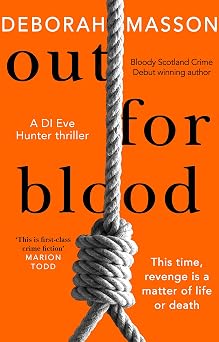
Out For Blood
Deborah Masson brings a sharper, more contemporary edge to Aberdeen procedural crime fiction, integrating modern investigative techniques with the emotional intelligence that separates good detective novels from great ones. Her work prioritizes the human cost of violence—not through sentimentality, but through rigorous attention to how crimes fracture communities and test the resilience of investigators. Masson’s dialogue crackles with authenticity, and her procedural sequences never feel like exposition, instead becoming the natural rhythm of how real detectives move through a case. For readers fatigued by formula-driven procedurals, her nuanced approach to character and investigation offers genuine novelty.
Verdict: Modern procedural crime fiction that respects both the reader’s intelligence and the complexity of real investigation.

Dead Man’s Grave
Neil Lancaster’s contribution to Aberdeen crime fiction demonstrates how procedural rigor and narrative momentum can coexist without compromise. Dead Man’s Grave balances the meticulous work of investigation with the urgency of active danger, creating a book that satisfies both the procedural purist and the thriller reader. Lancaster’s policemen are competent professionals first and action heroes never—they think their way through problems, call for backup, and sometimes fail. The Aberdeen setting serves not as backdrop but as character itself, with the city’s particular topography, demographics, and institutional culture shaping how crimes occur and how investigations unfold. This is how procedural crime fiction should work: procedure creates tension, not the reverse.
Verdict: A masterclass in reconciling authentic procedure with compelling narrative—exactly what modern crime fiction should aspire to.

A MAYA THORNE MYSTERY
Get Dust and Bones Free
Justice runs deeper than drought.
Red dust. Shallow graves. A detective who hunts killers where the law runs thin and the nearest help is two hundred miles away.
You will also receive occasional new release emails. Unsubscribe anytime. No spam, ever.

THE UNIFORM
Jodie Lawrance’s The Uniform expands the procedural canvas by focusing on the frontline officers whose work feeds into detective investigation—the patrol officers, the first responders, the constables whose observations shape everything that follows. This approach refreshes the procedural genre by acknowledging that detective work is built on the foundation of uniform police work, a truth often obscured by narratives that privilege the detective. Lawrance writes with genuine affection for the unglamorous work of beat policing, showing how procedure operates from the ground up rather than the top down. For readers tired of detective-centric procedurals, this perspective offers both novelty and credibility, grounding the genre in the actual hierarchy and workflow of modern British policing.
Verdict: A necessary corrective to procedural convention that shifts focus from the detective to the system that enables detection.
The Reading Order
- DS Hutton Box Set — Douglas Lindsay
- Out For Blood — Deborah Masson
- Dead Man’s Grave — Neil Lancaster
- THE UNIFORM — Jodie Lawrance
Discover Phillip Strang
Phillip Strang’s DCI Isaac Cook series brings the same commitment to procedural authenticity and character development that defines the best Aberdeen crime fiction, with 19 books exploring London homicide investigation through the lens of a detective who understands that procedure is not bureaucratic obstacle but the very foundation of justice. For readers seeking to deepen their engagement with police procedural as a form, Strang’s work offers the kind of sustained, serious engagement with detective work that elevates the genre beyond entertainment into genuine literature.
As an Amazon Associate, Phillip Strang earns from qualifying purchases. This page contains affiliate links — buying through them costs you nothing extra.