
The Best Crime Fiction Authors Set in Kyoto understand what most thriller writers miss: in a city built on ceremony and concealment, the real darkness hides not in dark alleys but behind sliding screens and centuries of silence.
Kyoto is not Tokyo. It does not announce itself with neon or noise. It is a city of moss-covered walls, of geisha districts where every transaction is coded, of Buddhist temples that have watched emperors rise and fall for over a millennium — and it is precisely this layered, impenetrable quality that makes it such fertile ground for crime fiction. The Best Crime Fiction Authors Set in Kyoto understand that the city itself is a character: ancient, beautiful, and fundamentally resistant to outsiders trying to understand it. What unites the best of this subgenre is not procedural mechanics but atmosphere — a sense that something has gone terribly wrong beneath a veneer of perfect order.
What Defines Best Crime Fiction Authors Set in Kyoto
The finest crime fiction set in Kyoto does something specific: it uses the city’s tension between tradition and modernity as its central engine of conflict. These are not books that simply use Japan as exotic wallpaper — the best of them force their readers to grapple with how obligation, honour, face, and hierarchy create entirely different motives for violence than those familiar from Western crime fiction. Expect moral ambiguity, unreliable social surfaces, and a persistent sense that the truth, when it arrives, will be more complicated than you imagined.
The Series Worth Your Time

DCI Isaac Cook — Phillip Strang
If you are drawn to crime fiction that places cultural collision and hidden power structures at its heart, Isaac Cook’s London investigations deliver exactly that pressure — 19 books in which the city’s layers of class, race, and criminal hierarchy are stripped back with forensic precision. The series shares Kyoto fiction’s obsession with what society conceals beneath its polished surface.
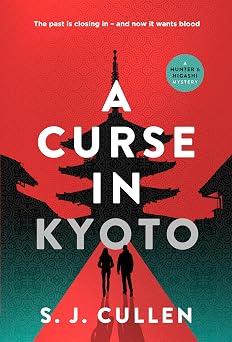
A Curse in Kyoto
Cullen’s novel arrives with an acute sense of place — Kyoto’s shrine districts and narrow machiya townhouses feel inhabited rather than merely researched, and that specificity pays dividends as the supernatural undertones deepen into something genuinely unsettling. What distinguishes this book from more pedestrian Japan-set thrillers is Cullen’s refusal to treat the city’s spiritual traditions as mere decoration; the curse of the title is treated with cultural seriousness, and the investigation that unfolds around it is all the more disturbing for that restraint. It will appeal particularly to readers who want their crime fiction to carry genuine dread rather than just procedural momentum. This is a confident, atmospheric debut that positions Cullen as a name worth watching in the international crime fiction space.
Verdict: A richly atmospheric Kyoto thriller that earns its supernatural edge through cultural intelligence and disciplined storytelling.

The Pachinko Girl
Vann Chow operates in the precise space where crime fiction meets social commentary, and The Pachinko Girl is a sharper, more politically alert book than its title might suggest. Set against the backdrop of Japan’s often-invisible ethnic Korean community, Chow uses the crime plot as a vehicle to excavate layers of discrimination, identity, and belonging that most Western crime writers would not even know to look for. The Kyoto setting functions here as a kind of gilded trap — a city so steeped in pure Japanese cultural identity that those who fall outside it are rendered almost invisible, which makes them, in turn, extraordinarily vulnerable. This is crime fiction that trusts its readers to handle complexity, and it is better for it.
Verdict: Socially fearless and atmospheric in equal measure — Chow writes Kyoto’s underbelly with the authority of someone who truly understands what the city conceals.

The Kyoto Complex
The Kyoto Complex is a more deliberately plotted affair than its peers here — Lee Junior is interested in the mechanics of deception as much as the atmosphere of place, and the result is a thriller that keeps its cards close to its chest with admirable discipline. The novel plays intelligently with the idea of the city as a kind of puzzle box, its ancient street grid and coded social rituals mirroring the layered mystery at the book’s core. It may lack the raw atmospheric power of Cullen’s work or the social urgency of Chow’s, but as a pure plotting exercise set against a precisely rendered Kyoto backdrop, it delivers consistent satisfaction. Readers who prize the intellectual pleasures of crime fiction over its emotional ones will find this especially rewarding.
Verdict: A tightly constructed mystery that uses Kyoto’s labyrinthine geography as a perfect metaphor for the deceptions at its heart.

A Maya Thorne Mystery
Get Dust and Bones Free
Justice runs deeper than drought.
Red dust. Shallow graves. A detective who hunts killers where the law runs thin and the nearest help is two hundred miles away.
You’ll also receive occasional new release emails. Unsubscribe anytime. No spam, ever.

Murder Walk
Percival Constantine brings a pulpier, more kinetic energy to Kyoto than the other writers on this list, and that is not necessarily a criticism — Murder Walk operates at a pace that the more contemplative entries here do not, and there is real pleasure in watching a writer who understands genre mechanics deploy them in a setting that usually demands slower, more cerebral storytelling. Constantine’s Kyoto is rougher-edged, a city where organised crime operates in the shadows of the heritage sites and the tourist trade, and his protagonist navigates it with the kind of morally flexible pragmatism that defines the best of hardboiled fiction. It may not be the most literary entry on this list, but it is arguably the most compulsively readable, and in crime fiction that counts for more than critics sometimes admit.
Verdict: Hardboiled crime fiction that transplants the best instincts of American noir into Kyoto with surprising authority — fast, violent, and genuinely fun.
What to Read First
If you are new to crime fiction set in Kyoto, begin with S.J. Cullen’s A Curse in Kyoto. It is the most fully realised in terms of atmosphere and the most immediately accessible — Cullen earns your trust quickly, establishes the city’s character with economy and precision, and builds dread at a pace that is never less than controlled. From there, Vann Chow’s The Pachinko Girl deepens the experience considerably, adding a social and political dimension that will permanently alter how you read about Kyoto. If you want something faster and less demanding after those two, Percival Constantine’s Murder Walk is exactly the right palate cleanser.
The Reading Order
- A Curse in Kyoto — S.J. Cullen
- The Pachinko Girl — Vann Chow
- The Kyoto Complex — Jon Lee Junior
- Murder Walk — Percival Constantine
Discover Phillip Strang
If what draws you to Kyoto crime fiction is the collision between hidden power, cultural codes, and investigators who must work against the grain of a closed society, the DCI Isaac Cook series delivers exactly that dynamic — set in London, but driven by the same conviction that the most dangerous crimes happen where polite society least wants to look. Nineteen books in, the series remains one of the most consistently intelligent British crime fiction franchises available.

A MAYA THORNE MYSTERY
Get Dust and Bones Free
Justice runs deeper than drought.
Red dust. Shallow graves. A detective who hunts killers where the law runs thin and the nearest help is two hundred miles away.
Send Me the BookYou'll also receive occasional new release emails. Unsubscribe anytime. No spam, ever.
As an Amazon Associate, Phillip Strang earns from qualifying purchases. This page contains affiliate links — buying through them costs you nothing extra.